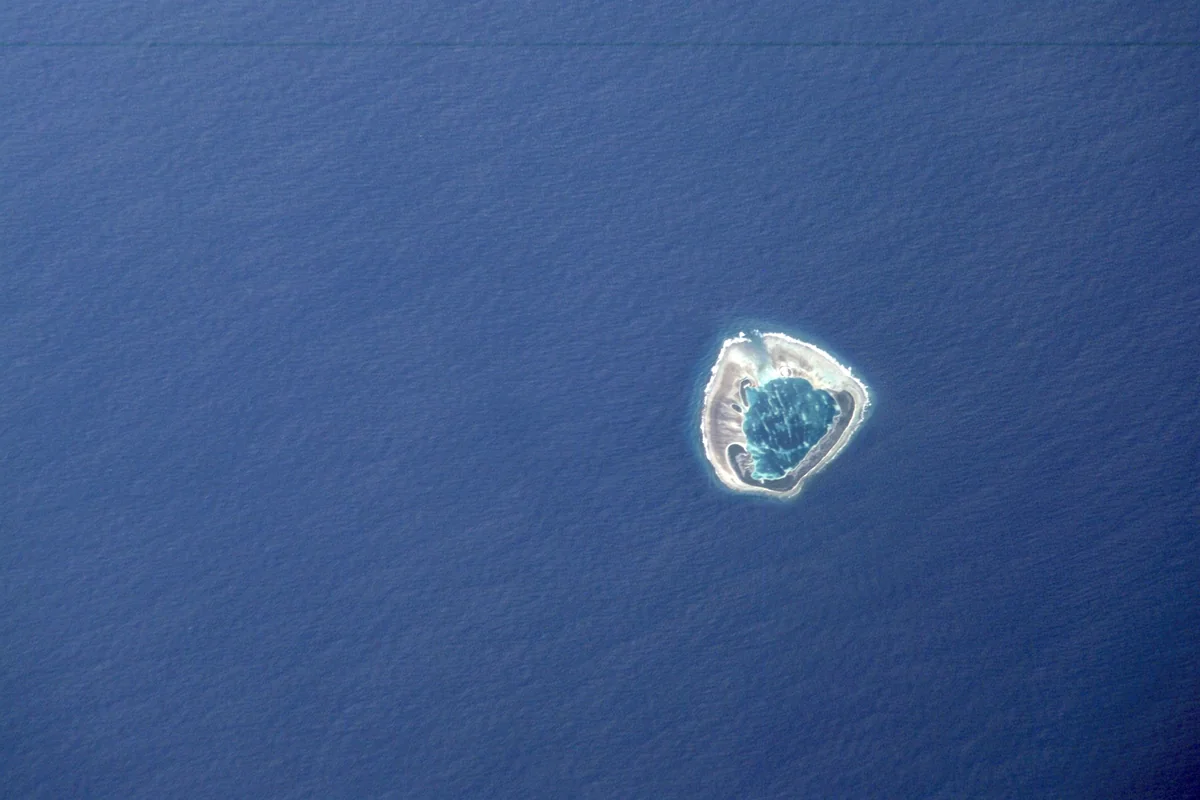
Ducie Island
≈2,688 kmA tiny coral atoll surrounded by open South Pacific. Its scale against the surrounding ocean helps make Point Nemo's isolation visible rather than abstract.
Image: NASA photograph · Wikimedia Commons
Globe Curiosities · Oceanic Isolation
Somewhere in the South Pacific is a point farther from land than anywhere else in the world's oceans. There is no island there, no city and no marker — only thousands of kilometers of open water.
01 · The oceanic pole
Point Nemo is the oceanic pole of inaccessibility: the point on Earth's ocean surface that is farther from land than any other location at sea.
NOAA places it at 48°52.6′ south, 123°23.6′ west in the South Pacific. The nearest pieces of land are roughly 2,688 kilometers away.
Nothing physically marks the point. It is a geographic solution — a location defined by distance from the surrounding land.
02 · Nearest land
NOAA identifies three nearest land areas: Ducie Island to the north, Motu Nui near Easter Island to the northeast and Maher Island in Antarctica to the south. Each is roughly 2,688 kilometers from Point Nemo.
A tiny coral atoll surrounded by open South Pacific. Its scale against the surrounding ocean helps make Point Nemo's isolation visible rather than abstract.
Image: NASA photograph · Wikimedia Commons
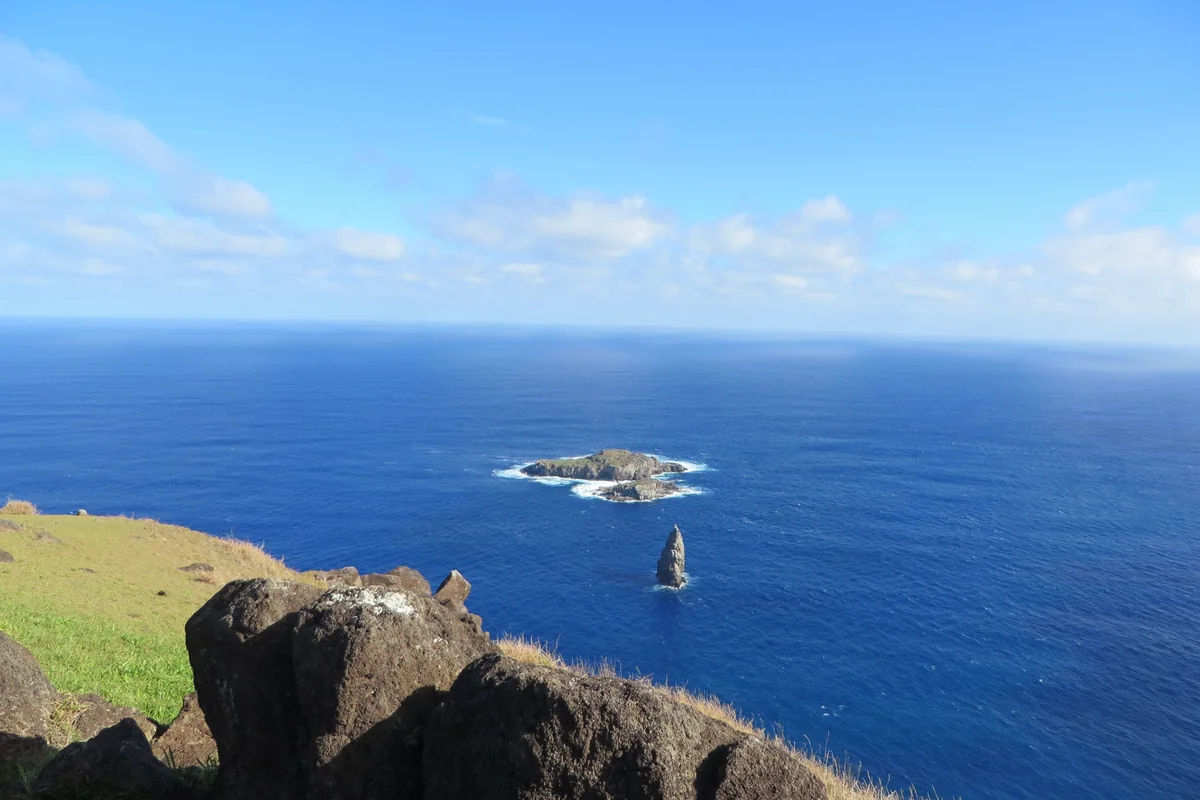
Motu Nui is a rocky islet just off Rapa Nui. From Point Nemo, even this small piece of land is still roughly 2,688 kilometers away.
Photo: Yasna sunflower / Wikimedia Commons · CC BY-SA 4.0
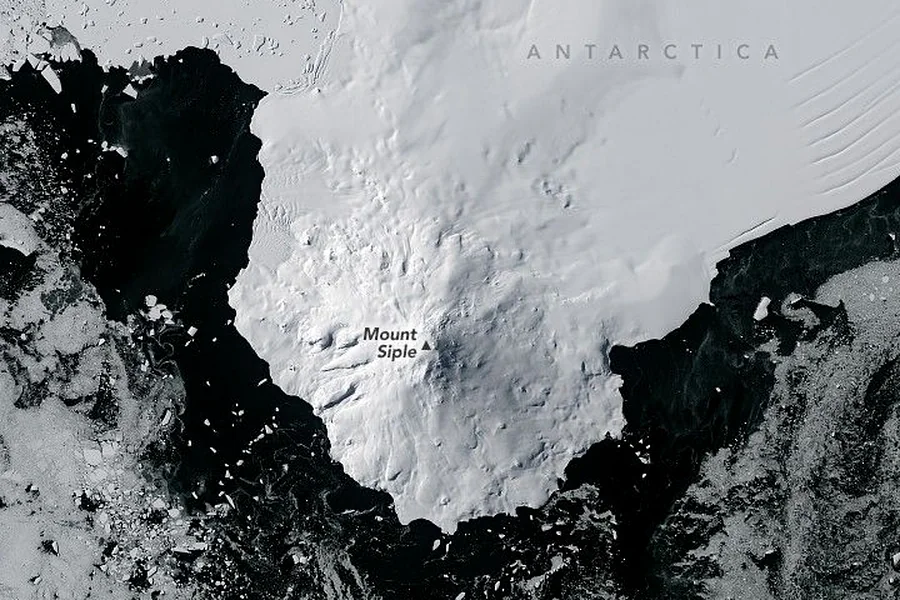
This satellite image is used as regional geographic context for the Maher / Siple Island area. It is not presented as a close-up photograph of Maher Island itself.
Image: NASA Earth Observatory · Landsat 9 / USGS · Maher / Siple Island regional context
03 · Why here?
Imagine measuring the distance from every point in the ocean to the closest piece of land. Most points quickly meet a coast or island.
The oceanic pole of inaccessibility is the place where that nearest-land distance reaches its greatest value.
The enormous South Pacific contains enough uninterrupted ocean for the maximum distance to reach approximately 2,688 kilometers.
04 · Scale of isolation
The important number is not the size of Point Nemo — the point itself has no area. It is the enormous distance between that coordinate and the nearest land.
Draw a circle around Point Nemo with a radius of roughly 2,688 kilometers and no land reaches the center. That is what makes the location exceptional.
05 · From ocean to orbit
Large spacecraft do not always burn up completely during atmospheric reentry. For controlled reentries, operators can target remote ocean regions so surviving debris is kept far from people.
NASA describes a remote region of the Pacific as the “Spacecraft Cemetery.” Point Nemo became closely associated with that idea because of its extraordinary distance from inhabited land.
06 · What Point Nemo is not
Point Nemo is a coordinate on the ocean surface, not a physical island or rock.
Maps can place a marker there, but there is no permanent geographic monument floating at the coordinate.
Its significance comes from maximum isolation, not from being the geometric center of the ocean.
07 · Methodology
NOAA identifies Point Nemo as the ocean location farthest from land and places it at 48°52.6′S, 123°23.6′W.
NOAA gives a distance of approximately 2,688 kilometers to the nearest land, identifying Ducie Island, Motu Nui and Maher Island as the closest land areas.
The distance diagram above is conceptual. It is designed to communicate isolation clearly and is not a projected navigation chart.
NASA documentation is used for the explanation of controlled spacecraft reentry over remote ocean regions and the “Spacecraft Cemetery” nickname.
Keep exploring
Cross the International Date Line, see why Greenland grows on flat maps, or return to the Globe Curiosities collection.