
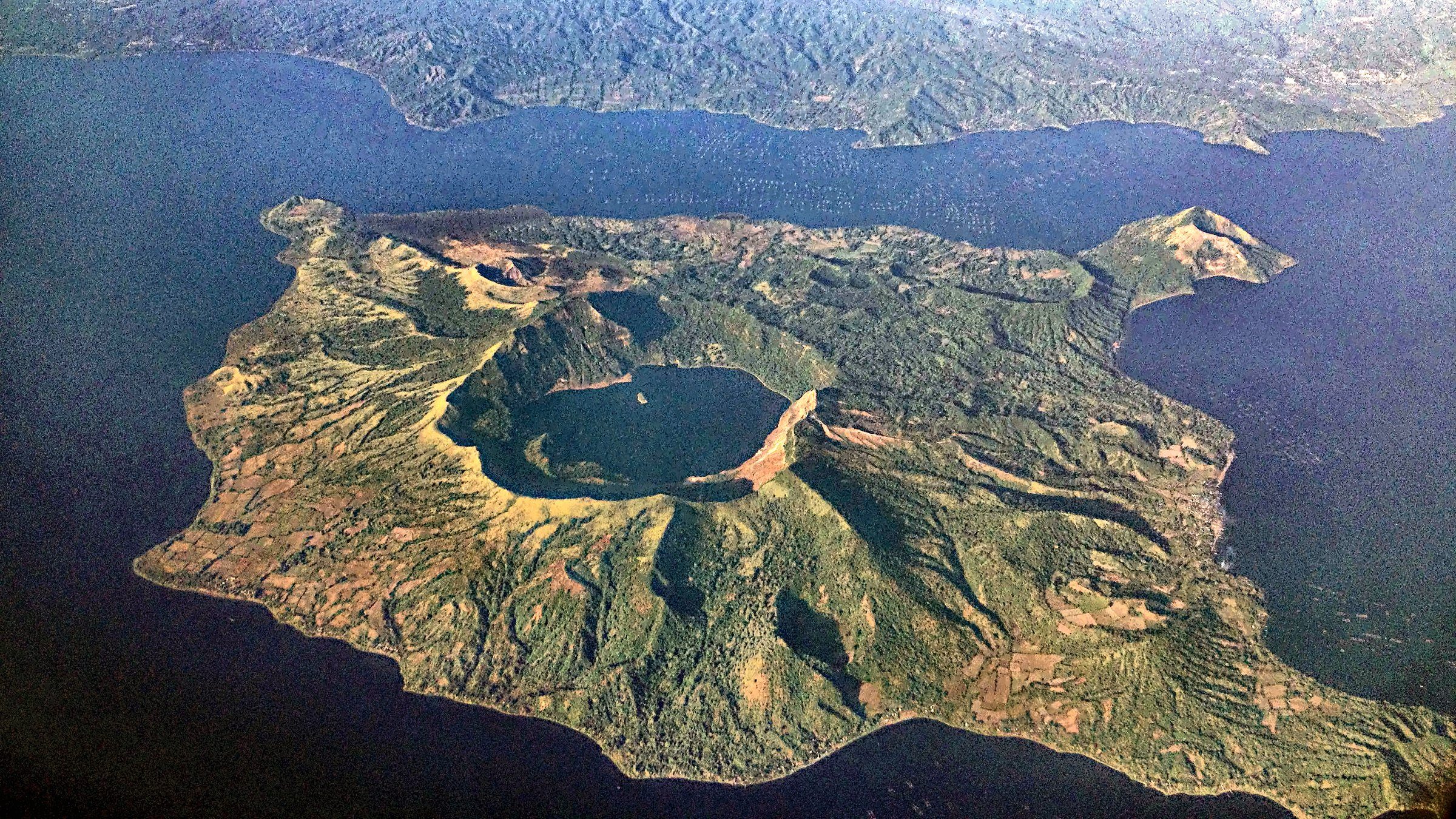

The nesting, level by level
Luzon, Lake Taal, Volcano Island, the crater lake and Vulcan Point.
Read the famous sentence backwards and it becomes a set of directions. Start on the largest island and keep going inward. Each level is a fraction of the size of the one before.
-
1
Island
Luzon
The largest island of the Philippines and the 15th largest on Earth, with the South China Sea on one side and the Philippine Sea on the other. About 64 million people live on it.
109,965 km²surrounded by ocean
-
2
Lake on that island
Lake Taal
A lake filling a volcanic caldera in south-west Luzon, also written Taal Lake. It is 25 km long, up to 172 m deep, and its surface lies only about 5 m above the sea.
234 km²third-largest lake in the Philippines
-
3
Island in that lake
Volcano Island
The active heart of Taal Volcano, rising 311 m from the middle of the lake. It is a Permanent Danger Zone and nobody is allowed to settle on it.
About 23 km²5 km from end to end
-
4
Lake on that island
Main Crater Lake
Water held in the island's main crater, which is about 2 km across. The lake is thought to have collected from rain.
1.2 km²inside the main crater
-
5
Island in that lake
Vulcan Point
A small rocky island breaking the surface of the crater lake. It is a remnant of an older crater floor that the lake filled in around.
One rockthe innermost island
How it formed
One volcano built four of the five.
Luzon was already there. Everything inside it is the work of Taal, a volcano that keeps collapsing, flooding and rebuilding itself.
The ground collapses
Very large prehistoric eruptions emptied the rock beneath Taal and left a caldera 25 to 30 km wide.
The caldera floods
The basin filled and stayed open to the sea at Balayan Bay. In 1754 an eruption choked its outlet, the Pansipit River. The level rose and, over centuries, the salt water turned fresh.
A volcano grows in the lake
Later eruptions piled up a new cone in the middle of the water. That cone is Volcano Island.
Its crater holds water
Rain collected in the island's main crater. One piece of the old crater floor stayed above the surface, and became Vulcan Point.
The sea left something behind. Lake Taal is home to the tawilis, a sardine that lives in fresh water, and to a sea snake that never returns to the sea.
After the 2020 eruption
Is Vulcan Point still there?
Yes, although for a few weeks in 2020 the sentence stopped being true. The lake around it vanished, and an island without water is only a rock.
Taal is active. It has erupted 39 times in recorded history, beginning in 1572. The innermost levels of this nesting can change in an afternoon.
Taal erupts from the main crater. Satellite images soon show that the water of Main Crater Lake has disappeared.
Water has returned to the crater.
- Since then
Rain from a series of typhoons refilled the lake, and Vulcan Point became an island again.
For reference
The numbers, and the other nested places.
Vulcan Point and Taal at a glance
- Country
- Philippines, province of Batangas
- Coordinates
- 14.01° N, 121.00° E
- From Manila
- About 50 km south
- Luzon
- 109,965 km²
- Lake Taal
- 234.2 km², up to 172 m deep
- Volcano Island
- About 23 km², 311 m high
- Main Crater Lake
- 1.2 km²
- Recorded eruptions
- 39, the first in 1572
It is not the only one
Victoria Island, Arctic Canada
An unnamed island sits in a lake, on an island, in a lake, on Victoria Island. It is the same depth of nesting as Vulcan Point, with no volcano involved.
Manitoulin Island, Lake Huron
The largest island in any lake, at 2,766 km². It has lakes of its own, and some of those lakes have islands.
Samosir, Sumatra
A 630 km² island in Lake Toba, which fills another volcanic caldera on another large island.
Quick answers
Questions people ask about Vulcan Point.
What is Vulcan Point?
Vulcan Point is a small rocky island in Main Crater Lake, the lake inside the crater of Taal Volcano in the Philippines. It is known as an island in a lake on an island in a lake on an island.
Where is the island inside a lake inside an island?
In Batangas province on Luzon, about 50 km south of Manila. Vulcan Point is in Main Crater Lake, which is on Volcano Island, which is in Lake Taal, which is on Luzon.
Is Lake Taal a lake inside a volcano?
Yes. Lake Taal fills the caldera of Taal Volcano. Volcano Island, in the middle of the lake, is the part of the volcano that is active today.
Is Vulcan Point still there after the 2020 eruption?
Yes. Main Crater Lake disappeared after the eruption of 12 January 2020, but water had returned by March 2020 and the lake refilled, making Vulcan Point an island again.
Can you visit Volcano Island?
The whole island is a Permanent Danger Zone and settlement is prohibited. Most people see the lake and the island from the ridge at Tagaytay, on the rim of the caldera. Check the current alert level from PHIVOLCS before going anywhere near the lake.
Don't stop here
One strange place leads to another.
You have just followed five geographic levels into one volcano. These three curiosities play with distance, color and remoteness in a very different way.

Why is this lake pink?
Another island, another extraordinary lake — but this time the water itself is the mystery.
Explore Lake Hillier →Photo: Yodaobione · Wikimedia Commons

Two islands. Two different days.
They sit only a few kilometres apart, yet the international date line makes them seem almost a day apart.
Explore the Diomedes →Photo: Wikimedia Commons

The place farthest from land.
No island nesting here. Just an ocean point farther from land than anywhere else on Earth.
Explore Point Nemo →Map: Wikimedia Commons
The short version
Vulcan Point is an island in Main Crater Lake, on Volcano Island, in Lake Taal, on Luzon.
Five levels inside one island of the Philippines, four of them made by a single volcano, and the smallest of them able to vanish and return within a season.