SeekGlobe · Globe Curiosities · Volcanoes
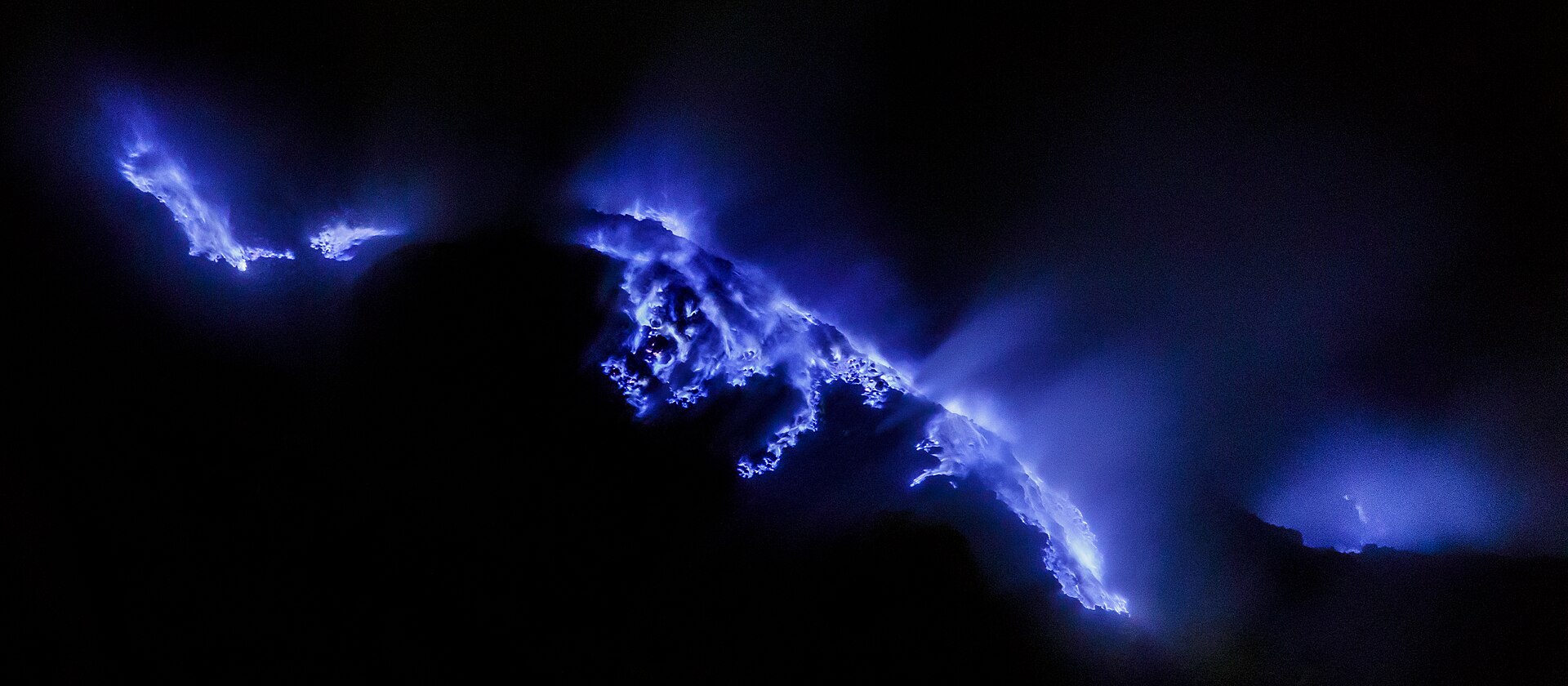
At night, the crater of Kawah Ijen in East Java fills with electric-blue flames. It looks like blue lava. It is not lava at all: it is sulfur on fire.
Photo: Thomas Fuhrmann, CC BY-SA 4.0
The short answer
Kawah Ijen releases huge amounts of hot sulfur gas through cracks in its crater. When that gas meets the air, it catches fire and burns with a blue flame. Molten rock here, like everywhere on Earth, glows red and orange.
What it looks like
Rivers of blue light running down the rock, as if the volcano were pouring out something no other volcano can.
What it is
Sulfur gas igniting in the air, and liquid sulfur that keeps burning as it runs downhill. That is what makes the "rivers".

How the blue fire works
Up to 600 °C
Gas rich in sulfur rises from the volcano and leaves through cracks in the crater floor, at high pressure and very hot.
Above 360 °C
When this hot sulfur gas touches the oxygen in the air, it ignites and burns.
Up to 5 m
The burning gas forms flames that can reach five metres high. Their colour comes from the sulfur itself.
Liquid sulfur
Part of the gas condenses into liquid sulfur. It keeps burning as it runs down the rock, which is what looks like blue lava.

Why blue, and why only at night
The colour of a flame depends on what is burning. Burning wood and molten rock glow orange. Burning sulfur gives off a blue light, the same blue you see when a little sulfur is lit in a laboratory.
The flames burn day and night, but they are faint. In sunlight they disappear against the bright crater. Only in darkness does the blue become visible.
The Ijen crater lake
Next to the blue fire lies a turquoise lake about one kilometre wide. It is described as the largest highly acidic crater lake in the world: its water is full of sulfuric acid from the gases rising through it.

How acidic is it?
Measurements in 2008 found about pH 0.5 at the edges of the lake and 0.13 in the middle.
Where the blue fire ends
Pipes channel the volcanic gas so it cools into molten sulfur, which hardens into bright yellow rock. Miners break it off and carry it out of the crater by hand, one of the hardest jobs on any volcano.


Where on Earth
 Java Trench
Kawah Ijen
Java
Jakarta
Indian Ocean
Kawah Ijen sits inside the Ijen caldera, on the border of the Banyuwangi and Bondowoso regencies in East Java. South of Java, the Indo-Australian Plate slides under the Eurasian Plate along the Java Trench. That collision feeds the long chain of volcanoes running across Indonesia.
Quick answers
No. Its lava is red and orange like any other. The blue comes from sulfur gas burning as it meets the air, and from liquid sulfur that keeps burning as it flows downhill.
Hot sulfur gas escapes from cracks in the crater at up to 600 °C and ignites in the air. Burning sulfur gives off blue light, producing flames up to 5 metres high.
Only at night. The flames burn all the time, but they are too faint to see in daylight.
Very. Its pH has been measured at about 0.5 at the edges and 0.13 in the middle, more acidic than battery acid. It is described as the largest highly acidic crater lake in the world.
In the Ijen volcano complex in East Java, Indonesia, on the border of the Banyuwangi and Bondowoso regencies, just west of Bali.
The short version