
SeekGlobe · Globe Curiosities · Volcanoes

The Volcano That Was Born in a Cornfield

On 20 February 1943, the ground split open in a farmer's field in western Mexico. By the next day there was a hill 50 metres high. Nine years later it was a volcano 424 metres tall, and scientists had watched every stage.

Black and white photograph from 1943 of Parícutin erupting a huge column of ash, with dead trees and a field of fresh lava in front and a small figure standing at the lava's edge
Parícutin in 1943, its first year. The small figure at the edge of the lava gives the scale.Photo: Bodil Christensen, public domain

The short answer

A brand-new volcano, from its first day to its last.

Parícutin is the youngest volcano in Mexico. It is one of the very few volcanoes on Earth whose whole life, from birth to the end of its eruption, was seen and recorded.

  • 20 Feb 1943The afternoon a crack opened in Dionisio Pulido's cornfield.
  • 424 mThe final height of the cone above the field where it was born.
  • 9 yearsHow long it erupted, from 1943 until it fell silent in 1952.
Colour slide from 1943: a person wrapped in a checked blanket watches a young black cinder cone release a tall column of ash above farmland
A local resident watches the new cone, months after its birth, in 1943.Photo: K. Segerstrom, USGS, public domain

The afternoon it began

The ground opened where the corn was planted.

For weeks, people near the village of Parícutin had heard rumbling underground. At about 4 pm on 20 February 1943, Dionisio Pulido and his wife Paula watched a crack about 2 metres wide open in their field. Smoke and ash began to pour out of it.

By the next morning the crack had built a cone of black cinders. A new volcano was growing in the middle of farmland, far from any other active vent.

"This volcano is owned and operated by Dionisio Pulido."The sign Pulido later put up near the volcano

A mountain you could watch grow

From a crack to a 424-metre cone.

Each eruption threw out cinders that piled up around the vent, so the cone grew taller and wider at the same time. Within eight months it was taller than the Eiffel Tower.
Eiffel Tower, 330 m
  • After one day50 m
  • After one week≈ 100 m
  • After four months200 m
  • After eight months365 m
  • When it stopped, 1952424 m
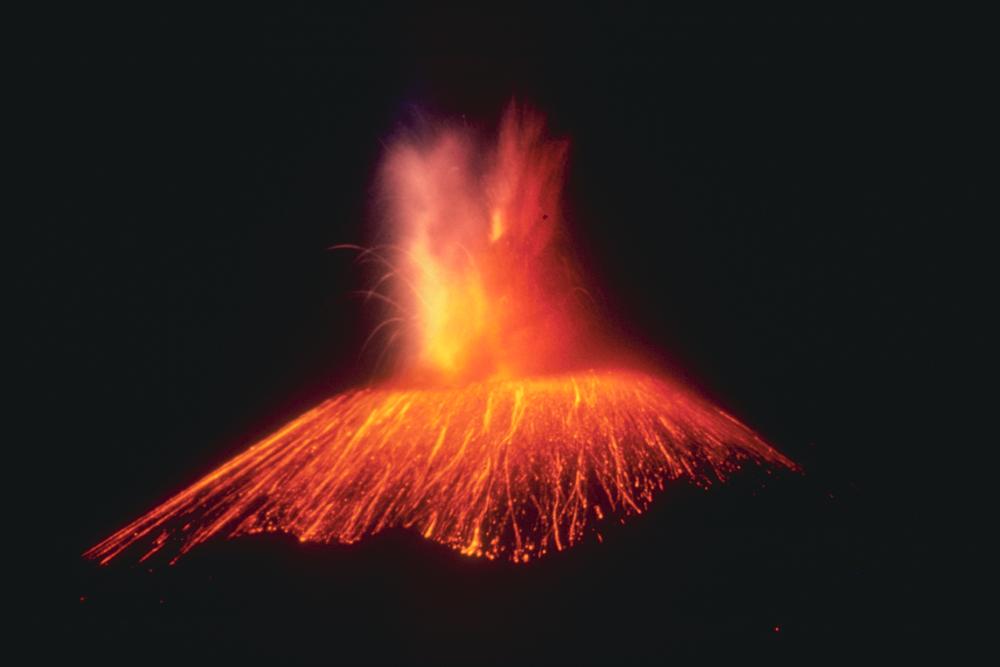
Parícutin at night in 1943: glowing lava bombs arc out of the crater and roll down the sides, tracing the shape of the cone in orange light
At night in 1943, glowing lava bombs trace the shape of the growing cone.Photo: R. E. Wilcox, USGS, public domain

Why scientists care

The first volcano of its kind watched from birth to death.

Before 1943, no one had followed this type of volcano through its whole life. Geologists from Mexico, the United States and elsewhere mapped it, measured it, sampled it and photographed it for years.

  • Whole lifeThe first full record of a cinder-cone volcano's life cycle
  • ≈ 50 papersScientific articles published about it between 1943 and 1948
  • ThousandsOf photographs and rock samples collected during the eruption
  • One witnessCeledonio Gutiérrez kept observing alone after the geologists left in 1948
The stone bell tower and ruined front of the church of San Juan Parangaricutiro rising out of a field of black lava under a cloudy sky
The church of San Juan Parangaricutiro today. The lava filled the town around it.Photo: Shanti Hortiales, CC BY-SA 4.0

The buried town

Only the church rose above the lava.

In June 1943, lava began moving toward the village of Parícutin, and its people left. The larger town of San Juan Parangaricutiro, home to about 1,900 people, was evacuated next.

By August 1944 most of both towns lay under lava and ash. Of San Juan, only the church's stone tower and part of its front are still visible. The rest of the town is beneath the rock you walk on.

Wide view of the ruined church standing alone in a field of black lava overgrown with shrubs, with forested hills behind
The church stands alone in the lava field that covered the town.Photo: LBM1948, CC BY-SA 4.0
Close view of carved stone church walls covered in moss, half swallowed by blocks of black lava
Carved stone, moss and lava, side by side inside the ruins.Photo: LBM1948, CC BY-SA 4.0
  • 26 km²Covered by lava
  • 233 km²Destroyed or heavily damaged
  • 2 townsBuried: Parícutin and San Juan Parangaricutiro
  • No oneWas killed by the lava; three people died from lightning in the ash clouds

Where on Earth

In a field of 1,400 volcanoes.

Parícutin lies in Michoacán, about 320 km west of Mexico City, on the Trans-Mexican Volcanic Belt. It is the youngest of roughly 1,400 vents in the Michoacán–Guanajuato volcanic field. Volcanoes like this usually erupt only once; the next one here will most likely appear somewhere new.

The globe turned to Mexico, with the Trans-Mexican Volcanic Belt drawn as a dashed line across the country and Parícutin and Mexico City marked Trans-Mexican Volcanic Belt Parícutin Mexico City Pacific Ocean Gulf of Mexico
The volcanic belt, drawn by hand on the SeekGlobe globe.
The bare grey cone of Parícutin today, rising above a wide field of black blocky lava dotted with young trees
Parícutin today, above the lava field it made. Trees are slowly returning.Photo: ben_kitchener3, CC BY 3.0
  • 2,800 mSummit height above sea level
  • 19.49° NOn the northern slope of Pico de Tancítaro
  • 29 kmWest of the city of Uruapan
  • 1997Named one of the Seven Natural Wonders of the World by CNN

Nine years, in order

The life of a volcano.

  1. 20 February 1943

    At about 4 pm, a crack opens in Dionisio Pulido's cornfield and begins to erupt.

  2. 21 February 1943

    A cone of cinders about 50 m high stands where the field was.

  3. June 1943

    Lava advances on the village of Parícutin, and its people are evacuated.

  4. October 1943

    A second, more violent phase begins. By early 1944, most of the cone's height has been built.

  5. 1944

    Lava covers San Juan Parangaricutiro. By August, only the church rises above it.

  6. 1952

    After a final burst of activity, the eruption ends. The cone stands 424 m above the old field.

Quick answers

Questions people ask about Parícutin.

How was Parícutin formed?

On 20 February 1943, a crack opened in a cornfield in Michoacán, Mexico, and began erupting ash and cinders. The cinders piled up around the vent and built a cone that reached 50 m in a day and 424 m by 1952.

How fast did Parícutin grow?

About 50 m in its first 24 hours, around 100 m in its first week, 200 m after four months and 365 m after eight months. It reached its final height of 424 m when the eruption ended in 1952.

Is Parícutin still active?

No. It erupted from 1943 to 1952 and has been quiet since. Cinder cones like Parícutin usually erupt only once, so a future eruption in the region would most likely form a new volcano elsewhere.

What happened to the church of San Juan Parangaricutiro?

Lava buried the town of San Juan Parangaricutiro in 1944. Only the church's stone tower and part of its front still stand above the lava field.