
Sailing StonesThe rocks that move across the desert.
Across a dry lakebed in Death Valley, stones leave long tracks in the mud. They appear to have traveled on their own. The remarkable part is that scientists have now watched the movement happen.
Racetrack Playa, California — where a rare combination of water, thin ice and wind can set rocks in motion.
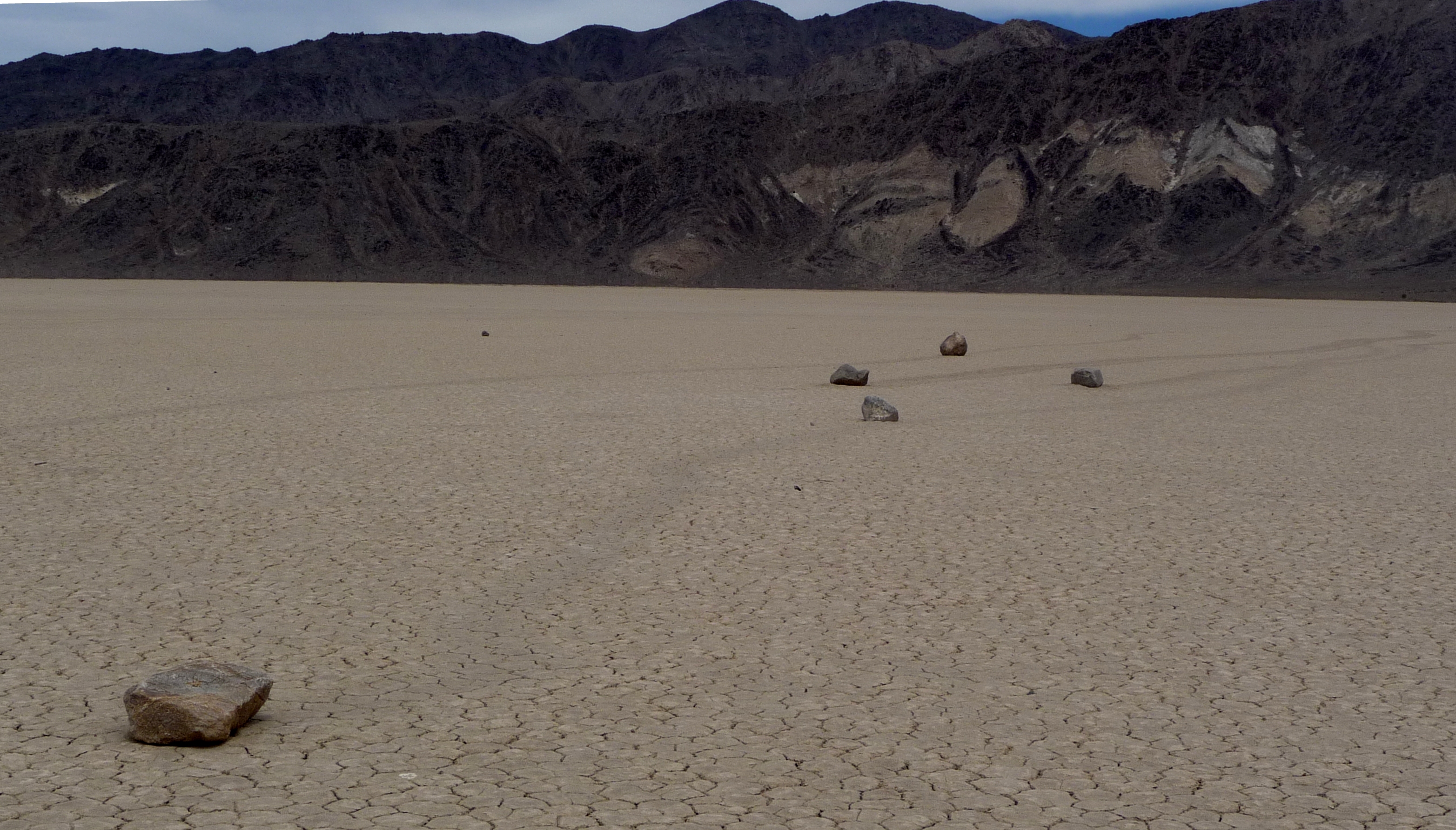
01. A dry lakebed with moving rocks
Racetrack Playa is a dry lakebed in Death Valley National Park, California. It lies in a remote valley between the Cottonwood and Last Chance Ranges. Across its nearly level surface, scattered stones sit at the ends of long, sometimes curved trails.
A playa is a basin floor that can collect water temporarily and then dry out. Fine sediment settles across the surface; as the mud dries, it contracts into the familiar pattern of cracks. At the Racetrack, rocks from the surrounding mountains reach the lakebed, where their movements can leave visible records in the soft ground.
Why do the sailing stones move? Researchers directly observed thin floating ice, driven by wind, pushing rocks across a shallow, muddy pond. When the surface dried, the tracks remained.
02. The mystery was finally observed
For decades, scientists could see the trails but rarely the movement that created them. The rocks might remain still for years, and the conditions needed to move them were difficult to catch. Explanations involving wind, water and ice were investigated, but the decisive observation had not yet been made.
In 2011, a research team installed a weather station and fitted 15 test rocks with GPS instruments. In December 2013, the researchers encountered the conditions they had been waiting for. They recorded rocks moving and later published their findings in PLOS ONE in August 2014.
The study documented more than 60 rocks moving during one event. Some instrumented stones traveled as far as 224 meters across multiple movements during the winter. These measurements turned an apparent mystery into an observable physical process.
03. How can ice move a rock?
The process requires several conditions to come together. First, water collects on the playa. A cold night freezes the shallow pond into a thin sheet of ice. As the sun warms the surface, the ice begins to melt and break into floating panels. A breeze then pushes those panels across the water.
When a moving panel reaches a rock, it can push against it. The rock slides over the wet lakebed, leaving a trail in the mud beneath the shallow water. The ice does not need to lift the rock into the air or float it away.
In the documented events, the ice was only a few millimeters thick, and the rocks moved slowly, at roughly a few meters per minute. The important force was not an extraordinary storm but the combined action of wind on a broad sheet of floating ice.
The dry photograph shows the final result. The movement itself belongs to a different moment: a temporary winter pond, breaking ice and a gentle wind. The trail is the evidence left behind after the water disappears.
04. What do the tracks reveal?
Some tracks are long and nearly straight; others bend or run alongside neighboring trails. Their shapes record the direction of movement, not a permanent route followed by the stones. Wind direction, water movement and the changing ice can all influence the path.
The 2013–14 observations establish that ice-driven movement really occurs at Racetrack Playa. They do not mean that every historical trail must have formed under identical conditions. Researchers have also investigated other possible circumstances, including wind acting directly on rocks over a water-slickened surface.
The wider geographic lesson is that a landscape can preserve the evidence of a short-lived event for much longer than the event itself. A desert lakebed may look motionless for years, yet its surface records what happened during an uncommon combination of weather and water.
05. From moving stones to the wider atlas
For another landscape shaped by persistent wind, explore Slope Point in New Zealand. There, the evidence is written into the growth of trees rather than into mud. The two places are not nearby; they illustrate different ways that environmental forces become visible.
The Eye of the Sahara offers a different kind of geographic puzzle: a vast pattern of rock and erosion that becomes clearer from above. Both stories reward looking beyond the unusual image to understand the process that produced it.
Explore Globe Curiosities →Quick answers
Where are the sailing stones?
The best-known examples are at Racetrack Playa in Death Valley National Park, California, United States.
Do the rocks really move?
Yes. Researchers recorded movement with GPS instruments, photography and weather measurements during the winter of 2013–14.
What makes them move?
A documented mechanism involves thin floating ice panels pushed by wind across shallow water. The panels push rocks over the muddy lakebed.
Can visitors watch the rocks move?
Movement is rare and cannot be scheduled. Most visitors see the stones and their tracks, not the motion itself. The National Park Service asks visitors not to move or remove rocks and to avoid damaging the fragile playa surface.
Sources & further reading
National Park Service — The Racetrack. Location, landscape, access and protection of the playa.
Scripps Institution of Oceanography — Mystery Solved: Sailing Stones of Death Valley Seen in Action for the First Time, August 27, 2014.
Norris et al. — Sliding Rocks on Racetrack Playa, Death Valley National Park: First Observation of Rocks in Motion. PLOS ONE, 2014.
Racetrack Playa: Rocks moved by wind alone. Additional research on alternative movement conditions.